
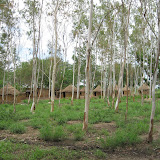
So we've been here at the training center for two weeks for our in-service training, and gnawing our hands off. The excitement of being with 60 Americans all day for two weeks quickly wore off as we realized with horror that there was no nap time! Barely even time for even tea between our packed schedule of technical lectures and language classes, field trips and administrative sessions designed to remind us that we are, in the end, owned by the government. But at nights we pitch a fire, and hopefully someone pulls out a guitar and harmonica as we sing soulful recreations of Beyonce and Outkast to the drum of an upside down bucket. Or maybe we spark up the hookah and toast some pumpernickel bread using a rake (we all could sure use the fiber), enjoying the comraderie of people who are just slightly crazy enough to live in a mud hut for two years in West Africa.
Luckily I've gotten out of the walls of the Training Center into Bamako a few times, where we dance feeling uncomfortably modest next to the blue eyeshadowed Malian prostitutes. Finally we head home to the sound of the 5am call to prayer, waking up at 9am to grab ice cream before heading back to sessions.
Even though I never felt the urge to see him in the US, a bunch of us decided to go to the Sean Paul concert, a fundraiser for Malaria prevention. It turns out Sean Paul is as bad in Mali as he is in the States. As he finally stepped on stage about 4hours after his promised arrival, the Gendarmes started to grow anxious looking at the rowdy crowd, and started to push us all. We moved like cattle, and in the rush I lost one of my shoes. Thankfully I found another on the ground, albeit an inch lower, and we hobbled our way to the exit right as a chair was thrown. A wise exit, and a warning never again to go to a big concert here.
And so as IST comes to an end, off I go to hike through Dogon country among the villages carved into the mountains.
Thursday, December 17, 2009

Friday, December 4, 2009
A moveable feast
While short, this week at site was chockfull of excitement. I came at the start of Seliba (Tabaski), a Muslim holiday celebrating Abrahams sacrifice of a ram instead of his son Ishmael (yes, the Koran places Ishmael, not Issac, in the knife's path - an interesting deviation from the Torah). In the days right before seliba, herds of goats and sheeps seemed to appear out of thin air: blocking the streets of the teeming markets, nipping at my feet on the bus ride to village, trying their best to get into my yard by gnawing my wood gate. As I walked into my host family's concession, the slaughter was already beginning. On a tarp over the sand I watched as the goat was killed, skinned and cut into intricate shapes, taking it apart with surgical precision. I'll spare you the details. Over the next two days I ate a myriad of interesting, seemingly inpalatable body parts. Out came entrails flavored with Maggi, tounge, pancreas and lung (?) amid peanut sauce and potatos, a very gluey hoof, and a majestic bowl full of grilled goat's head. The last was (alarmingly) delicious. Grotesque, yes. But there is some beauty to this idea of sacrifice, a long forgotten acknowledgement of our need to kill these beasts for our own life. Until now I never quite grasped the disconnect that is present in cultures where access to proteins and micronutrients is a daily given. When most of the villagers can afford meat only every other week, if that, each part of that animal becomes an opportunity for their children to grow strong (cue the Lion King's Circle of Life). Yes, here even the gluey hoof is useful and worthy of attention, and damn good protein. Killing with love.
The rest of my time was spent in the usual way. Mornings at the health center weighing babies, painting murals, or just chatting with the patients, health workers, or the usual characters that just, well, hang out. Afternoons hiding from the sun, reading or listening to the BBC on my shortwave radio, getting water, etc. Since the cold season is approaching (despite the 90 degree afternoons), in the evenings everyone huddles around the bonfires pitted in the middle of the yard, drinking their tea and listening to radio. The hilarity has been lost on me as my body temperature has apparently switched to Sub-Saharan mode. The other day, shivering in my sweatshirt, I looked at my thermometer, which was at an embarrasing 65 degrees. I am sure it is snowing in New York by now. I can't really understand that.
The other night, as I headed to my hut for my usual 9am bedtime (what else is there to do with no electricity?) I heard drums rumbling somewhere in the dark village. The next day the beating started again, and I finally discovered the donkiliyoro (dancing place), where the young village women and some men were gathered in a circle in celebration of an engagement. The women were feverously dancing in front of the three drummers, their hands thrown up behind their back and their torsos bent - birds of paradise in vibrant flower prints. The three men pounded their djambes (drums) with "snares" made of pieces of scrap metal, in front of a small bonfire which softened the drum, creating a deep bellowing sound. Soon, almost on cue, the three women would move out and a new group of girls would twirl in, dancing synchronously as the crowd began a call and response song. They danced and sang with such enviable ownership. This culture, these traditions are not the dusty cliche of their grandparents. It is theirs and they create it with each village dance, with the rhythms that have been drummed for centuries. The headwraps flew and panye (wrap skirts) adjustments were made as the party raged on through the night. I went back to my hut around 10pm, finally falling asleep to the rhythmic beats of the drums.
The rest of my time was spent in the usual way. Mornings at the health center weighing babies, painting murals, or just chatting with the patients, health workers, or the usual characters that just, well, hang out. Afternoons hiding from the sun, reading or listening to the BBC on my shortwave radio, getting water, etc. Since the cold season is approaching (despite the 90 degree afternoons), in the evenings everyone huddles around the bonfires pitted in the middle of the yard, drinking their tea and listening to radio. The hilarity has been lost on me as my body temperature has apparently switched to Sub-Saharan mode. The other day, shivering in my sweatshirt, I looked at my thermometer, which was at an embarrasing 65 degrees. I am sure it is snowing in New York by now. I can't really understand that.
The other night, as I headed to my hut for my usual 9am bedtime (what else is there to do with no electricity?) I heard drums rumbling somewhere in the dark village. The next day the beating started again, and I finally discovered the donkiliyoro (dancing place), where the young village women and some men were gathered in a circle in celebration of an engagement. The women were feverously dancing in front of the three drummers, their hands thrown up behind their back and their torsos bent - birds of paradise in vibrant flower prints. The three men pounded their djambes (drums) with "snares" made of pieces of scrap metal, in front of a small bonfire which softened the drum, creating a deep bellowing sound. Soon, almost on cue, the three women would move out and a new group of girls would twirl in, dancing synchronously as the crowd began a call and response song. They danced and sang with such enviable ownership. This culture, these traditions are not the dusty cliche of their grandparents. It is theirs and they create it with each village dance, with the rhythms that have been drummed for centuries. The headwraps flew and panye (wrap skirts) adjustments were made as the party raged on through the night. I went back to my hut around 10pm, finally falling asleep to the rhythmic beats of the drums.
Thursday, November 26, 2009
Running water
A good month. It started with Halloween - the insanity of such a frivolous, fabulous holiday magnified by the bewildered Malians as we stepped out of the Kita house dressed as super heros, millet stalks, Bush taxis and a vertitable cast of characters. Kristen and I went as two mut huts, complete with a broom shoved on our heads for our straw roofs. Costumes slowly stripped away as the night blazed with dancing, plastic bags of gin and hulahooping. There is such a luxury that comes with letting your strange Americaness float comfortably among other Westerners, flinging off the awkwardness that cloaks you in village as you fret to cover your knees and respect the cekorobas (old men). Speaking of which, I heard a fantastic Malian proverb the other day:
"You can jump over the old man's excrement, but you can't jump over his speech."
After Halloween a few of us jumped into Bamako for a few days. I had an HIV awareness meeting to attend, and we tried our best to soak in the Bamako goodness: ice cream, diet coke, chinese food. The post Halloween party was still roaring there, and we spent most of our time at our friends house, talking amongst the carved watermellon jackolanterns and the persuasive call of the Mosque next door at prayer time. Heading back we bumped into a fellow Kita friend and hopped on the night bus back to Kita, where the three of us squished into a two sear row as goats wrapped in sacks whined on the roof above us. When I came back I discovered that my computer had contracted a nasty virus - too many dirty flashdrives. Its out of commission until I get back to Bamako for training in December.
Despite my anticipation at returning to village - laughable Bambara, annoying children and ego challenges looming ahead - I reached the pink tipped millet fields and friendly straw roofs with a sigh of relief. The relief was short lived as I ran straight to the toilet, beginning my two weeks of contemplating the ingenuity of the Bambara word for diarrhea, konoboli (running stomach). Between bathroom trips though I was able to begin the incredibly uncomfortable experience of my Baseline Survey. My humility soared as I asked the chief of the village if he had heard of STIs and, not realizing I was talking to the Imam (Moslim priest), I asked, amid a cloud of 20 children, if he knew where to buy condoms. Still, I left each family with a sense of purpose, and I am ingraining my purpose into this village as I try to understand what my role is here. A representative for the Women's Association came up to me and asked if I could help them create a women's garden, which should be an interesting project. Thankfully my site mate is an environmental volunteer, so hopefully we can get that project started together.
The usual sadness still greets me at the health center though. A woman 8 months pregnant finally coming in for her first pre-natal consultation, so weak due to her severe anemia her husband finally gave her the money to come. As we put her on an IV a grandmother holds her one year old grandson convulsing with cerebral malaria, and she is screaming "Oh Allah!" over and over through glassed over eyes. We try to put an IV in the child's tiny hands and feet but can't find a vein with his extremities bloated with edema, the body's desperate attempt to keep hydrated depsite malnutrition.
As my language becomes more coherent, I have finally been able to make friends here, a task that is harder than it seems as many people either see me as a bumbling awkward outsider who can't understand a word or are trying to see how much they can get out of me. I think I might pull my hair out if I hear "Where is my present?" one more time. Still, I try to remind myself that manners is as cultural as anything else. And with real friends I am starting to have some real conversations about living here. As Soliba and I discussed the difference in families in our countries, I tried to explain why it was not only okay but even (fully aware of my Western ethnocentricity) better to have less children (7 is the average for Malian women). She was incredulous when I told her that americans have 2-3 children on
average, and asked me:
"But what if one of your children dies?"
From an isolated point of view this logic seems flawless - the more children you have the more they can work for the family. This is also one of the values that is written in the Koran. And since almost a quarter of children die before the age of 5, this loss must be accounted for. My limited Bambara tried to
explain that children in the US dont die as often because their
parents have fewer children, and can take better care of each one. But
who am I to tell them to reject their culture, and how do they grasp
that they can slowly get themselves out of poverty by having less
kids? (this is arguably the key cause of their poverty and the world's
food crisis).
Such a sad reminder of this vicious cycle of poverty and tradition.
Poverty perpetuated by tradition, naivety.
(Is this their leaders fault, or the population that doesn't ask for better?)
A need for stability through tradition perpetuated by poverty.
(Is this our fault?)
This shouldn't be something anyone should get used to.
After two weeks and many bathroom trips I headed back to Kita and discovered that I have a stomach parasite. Not really a shocker. We spent a few days with our tutor under the guava tree as I got through the intense anti-parasitic medicine which made my water taste like metal. Me and my friend jumped on the 1am bus to a big Thanksgiving gathering with tons of other PCVs. We made 20 pies, killed 5 turkeys and filled a bucket with fruit salad, another with stuffing and mashed potatos. The next day, despite our food and whisky hangovers, 12 of us decided to head to a nearby waterfall. All of us somehow squeezed into a sedan, and I spent the two hour trip with the clutch awkwardly in between my thighs. When we passed the Gendarme (police) stop a few people climbed onto the roof, ducking renegade tree branches as we bounced through the path as if on a dried up narrow river bed. We teetered on the narrow bridge made of a few bamboo branches stuck together and hiked, following the sound of the water. The waterfalls were incredible. We climbed up the rocks, hoisting ourselves up with vines, and jumped off the rainbow tinted waterfalls into the shimmering pool 20 feet below. Beautiful.
"You can jump over the old man's excrement, but you can't jump over his speech."
After Halloween a few of us jumped into Bamako for a few days. I had an HIV awareness meeting to attend, and we tried our best to soak in the Bamako goodness: ice cream, diet coke, chinese food. The post Halloween party was still roaring there, and we spent most of our time at our friends house, talking amongst the carved watermellon jackolanterns and the persuasive call of the Mosque next door at prayer time. Heading back we bumped into a fellow Kita friend and hopped on the night bus back to Kita, where the three of us squished into a two sear row as goats wrapped in sacks whined on the roof above us. When I came back I discovered that my computer had contracted a nasty virus - too many dirty flashdrives. Its out of commission until I get back to Bamako for training in December.
Despite my anticipation at returning to village - laughable Bambara, annoying children and ego challenges looming ahead - I reached the pink tipped millet fields and friendly straw roofs with a sigh of relief. The relief was short lived as I ran straight to the toilet, beginning my two weeks of contemplating the ingenuity of the Bambara word for diarrhea, konoboli (running stomach). Between bathroom trips though I was able to begin the incredibly uncomfortable experience of my Baseline Survey. My humility soared as I asked the chief of the village if he had heard of STIs and, not realizing I was talking to the Imam (Moslim priest), I asked, amid a cloud of 20 children, if he knew where to buy condoms. Still, I left each family with a sense of purpose, and I am ingraining my purpose into this village as I try to understand what my role is here. A representative for the Women's Association came up to me and asked if I could help them create a women's garden, which should be an interesting project. Thankfully my site mate is an environmental volunteer, so hopefully we can get that project started together.
The usual sadness still greets me at the health center though. A woman 8 months pregnant finally coming in for her first pre-natal consultation, so weak due to her severe anemia her husband finally gave her the money to come. As we put her on an IV a grandmother holds her one year old grandson convulsing with cerebral malaria, and she is screaming "Oh Allah!" over and over through glassed over eyes. We try to put an IV in the child's tiny hands and feet but can't find a vein with his extremities bloated with edema, the body's desperate attempt to keep hydrated depsite malnutrition.
As my language becomes more coherent, I have finally been able to make friends here, a task that is harder than it seems as many people either see me as a bumbling awkward outsider who can't understand a word or are trying to see how much they can get out of me. I think I might pull my hair out if I hear "Where is my present?" one more time. Still, I try to remind myself that manners is as cultural as anything else. And with real friends I am starting to have some real conversations about living here. As Soliba and I discussed the difference in families in our countries, I tried to explain why it was not only okay but even (fully aware of my Western ethnocentricity) better to have less children (7 is the average for Malian women). She was incredulous when I told her that americans have 2-3 children on
average, and asked me:
"But what if one of your children dies?"
From an isolated point of view this logic seems flawless - the more children you have the more they can work for the family. This is also one of the values that is written in the Koran. And since almost a quarter of children die before the age of 5, this loss must be accounted for. My limited Bambara tried to
explain that children in the US dont die as often because their
parents have fewer children, and can take better care of each one. But
who am I to tell them to reject their culture, and how do they grasp
that they can slowly get themselves out of poverty by having less
kids? (this is arguably the key cause of their poverty and the world's
food crisis).
Such a sad reminder of this vicious cycle of poverty and tradition.
Poverty perpetuated by tradition, naivety.
(Is this their leaders fault, or the population that doesn't ask for better?)
A need for stability through tradition perpetuated by poverty.
(Is this our fault?)
This shouldn't be something anyone should get used to.
After two weeks and many bathroom trips I headed back to Kita and discovered that I have a stomach parasite. Not really a shocker. We spent a few days with our tutor under the guava tree as I got through the intense anti-parasitic medicine which made my water taste like metal. Me and my friend jumped on the 1am bus to a big Thanksgiving gathering with tons of other PCVs. We made 20 pies, killed 5 turkeys and filled a bucket with fruit salad, another with stuffing and mashed potatos. The next day, despite our food and whisky hangovers, 12 of us decided to head to a nearby waterfall. All of us somehow squeezed into a sedan, and I spent the two hour trip with the clutch awkwardly in between my thighs. When we passed the Gendarme (police) stop a few people climbed onto the roof, ducking renegade tree branches as we bounced through the path as if on a dried up narrow river bed. We teetered on the narrow bridge made of a few bamboo branches stuck together and hiked, following the sound of the water. The waterfalls were incredible. We climbed up the rocks, hoisting ourselves up with vines, and jumped off the rainbow tinted waterfalls into the shimmering pool 20 feet below. Beautiful.
Wednesday, November 4, 2009


Wednesday, October 28, 2009
Yesterday was another torrential rainstorm. Fanta grabbed me with words of "old woman" and "fever," and we went to see the old dying woman. We met up with Sangare, the doctor, who gave the unsuprising diagnosis - malaria - which is literally ravaging our village this time of year during the rainy season. We found her under bright purple sheets sown with green flowers, her shallow breaths contrasting with the feverent pumping rain. When it died down for a moment, she got up and walked, shakily gripping the walls as we sat shelling peanuts. As she reached the nyegen she looked back vacantly as the wind played games with her green headwrap. Her grip on the mud wall seemed to teeter between worlds, her stare exhausted and vacant. The next day I went out to the peanut fields with Fanta and a few other women. Our hands and heads and backs were filled with gourd bowls, radios, water jugs and little girls. We sat under a tree and pulled the peanuts from the roots as we exchanged warm but confused sentiments about farming and the village. Our picinic lunch of fresh sweet milk with millet and cut cucumber was refreshing, and I finally felt welome into this community of strong women, even though they make constantly make fun of my smooth uncalloused hands and lack of a husband. We left as again the black clouds rolled in, and ran the last half kilometer to the village as the rain slowly crept up on our heads.
I returned after the fields to give my blessings to the old woman, and then went to sit with Nasira as she cooked dinner - peanut sauce and to (ground millet patties) over a mud fire pit. The next morning the old woman had died. Fanta had no tears as she told me - she went on pounding millet. Of course, she had eleven children, another wife and a husband to feed.
I returned after the fields to give my blessings to the old woman, and then went to sit with Nasira as she cooked dinner - peanut sauce and to (ground millet patties) over a mud fire pit. The next morning the old woman had died. Fanta had no tears as she told me - she went on pounding millet. Of course, she had eleven children, another wife and a husband to feed.
10/13/09 ? I am losing track of the days...

Today I woke up after dreams of lying in Central Park listening to Belle and Sebastian with Gabby, a Starbucks white mocha frappaccino in hand. I was shocked to find myself under a mosquito net and a straw roof, listening to the donkeys morning wheeze. And there is no jarring sound like the donkeys first sounds in the morning - raggedly sucking in air in a tension filled shudder, and as soon as it seems like the poor malnourished beast's lungs have collapsed, it haws out a shrill choked exhale. Most of the day was spent in my usual way: mornings in the health center weighing babies, afternoon tea with the CSCOM staff, cooking lunch and studying Bambara as a crowd of aimless children stare at me, the evening tea and chat sessions followed by dinner with my host family. Still, I felt I was looking at my village through raw eyes, everything highlighted by the vibrant blue and yellow outlines that my anti-malaria medication fabricates. This is where I live? These are my neighbors, my friends, my co-workers? These straw huts with the swirling squash and cucumber vines - this is my home? What a strange, beautiful, simple world to be living in, so unlike the crisp, metallic New York! Even though the people asking me for money piss me off, the children laughing at my terrible Bambara is exasperating, and I haven't quite figured out how to successfully carry my water buckets on my head without getting soaking wet, its wonderful to live so intimately in this village. And despite the frequent loneliness that comes with being an outsider, and my (daily) efforts to get the children away who constantly swarm to my house (which is facing the school), I am amazed at how much I've integrated into the community in a month.
One thing I've been doing alot of is baby weighings at the CSCOM. During vaccination days on Mondays, women of the surrounding villages come, and I've tried to take this opportunity to weigh the 30+ babies there. In addition, almost daily children come to the CSCOM, for whatever reason, who are obviously malnourished. I've found that about 8 out of 10 children I've weighed are malnourished, either moderately or severely. Plumpy Nut, an ameliorated peanut butter distributed by UNICEF, has been a really helpful way to ensure that they are getting their daily protien and vitamin quota, which is so lacking in the typical Malian diet of rice and millet. But the French charts and guidelines are contradictory and confusing to me, and even more so to the other healthcare workers who seem to arbitrarily prescribe the peanut butter and make unconfident suggestions to the clueless parents. There is definitely something to the argument that literature and funding is great in terms of aid to developing countries, but taking the time to actually train the health workers in the rural villages is desperately needed, and inherently more sustainable than throwing money at a problem.
Saturday, October 17, 2009
Where There is No Gynecologist
Preventing cervical cancer in low resource settings
By Dina Carlin
"Women are not dying because of diseases we cannot treat...they are dying because societies have yet to make the decision that their lives are worth saving."
-Dr. Mahmoud Fathalla, former president of the International Federation of Gynecology and Obstetrics
In a country where female reproductive health is barely on the agenda, cervical cancer is an example of how modern medicine has stopped short in Mali, largely due to the low availability of resources. Each year there are 500,000 new cases of cervical cancer worldwide, and more than 80% of these cases occur in developing countries (1). According to the World Health Organization, cervical cancer is the most frequent cancer developed in Malian women, with 1,336 new cases each year. Meanwhile, 1,076 cases of cervical cancer in Mali each year result in death. These figures are projected to double in the next 15 years (2). While these statistics are sobering, cervical cancer happens to be one of the most preventable cancers with even infrequent screening. A household condiment, it seems, may be the answer.
The development of cervical cancer, caused by certain strains of the sexually transmitted virus HPV (the Human Papiloma Virus), has been strongly linked to socio-economic status. The increased prevalence of HPV in developing countries, as compared to rates in developed nations, is linked to a comprehensive list of factors, including access to sexual education, age of first sexual intercourse (25% of Malian women have sex before the age of 15), and availability of medical resources. However, the high incidence of cervical cancer is in large due to the lack of access to preventative healthcare. It is estimated that 21.5% of women in West Africa are infected with HPV, and this number has been climbing. In developed countries with fluid, accessible medical technology, the 'Pap' smear, a standard part of a gynecological exam, followed by colposcopy (laboratory analysis of cervical tissue) are well established methods to screen for HPV and precancerous cells. In addition, a vaccine that prevents two strains of HPV most frequently associated with cervical cancer has recently become widely available, albeit expensive. These efforts have led to sharp decreases in cervical cancer worldwide, with the exception of Sub-Saharan Africa. The high cost of these procedures, untrained and inexperienced healthcare providers, and the need for follow-up treatment create obvious barriers for impoverished countries such as Mali.
New procedures for diagnosing cervical cancer have been founded on the need for inexpensive screening methods that require minimal training and single visits to the health center. Since cervical cancer generally develops slowly, screening every 3-5 years, sources say, can have a significant impact in reducing mortality (3). While not as effective as the Pap smear, and certainly not as empirical as cytology, VIA, or visual inspection of the cervix with acetic acid (also known as household vinegar) is a groundbreaking alternative for the developing world. An alternative is VILA, visual inspection with Lugol's iodine, which is a slightly more expensive alternative. It involves only spraying the vinegar or iodine on the cervix, where the precancerous cells turn white in the case of vinegar, or brown with iodine. The simplicity of this procedure involves almost no equipment other than vinegar (widely available in most butigis) or iodine, and can be administered by any health worker.
Treatment for cervical cancer is key, as 95% of cases become fatal within two years. While treatment options vary, one of the cheapest, easiest and quickest treatments for cervical cancer is cytology, which involves "freezing" the cervix using carbon dioxide or nitrogen dioxide, killing off the precancerous cells. Most of the materials are locally available, the training is minimal, and the 15 minute procedure can be carried out by non-clinicians such as Matrons. In addition, it has a very low rate of complications, with cure rates of 85-91% (1).
So what do we do now? Since sustainability is key, working towards training healthcare workers such as Matrones to screen and treat cancer would decrease the impact of this highly destructive cancer. Finally, education and screening initiatives, with the aid of NGOs such as Prevent International Cervical Cancer Now (www.pincc.org) or the Alliance for Cervical Cancer Prevention would help bring the issue of cervical cancer to the national spotlight. Turning to simple and accessible technologies such as VIA and cryotherapy can create the foundation for effective preventative care in reproductive medicine. With all the tools available here in Mali to fight cervical cancer, it is time to decide to take action.
1 Sanghvi H., Lacoste M and McCormick M (eds). (2006). Preventing Cercical Cancer in Low-Resources Settings: From Research to Practice. Report of a conference in Bangkok, Thialand, 4-7 December 2005. JHPIGO: Baltimore, Maryland.
2 WHO/ICO Information Centre on HPV and Cervical Cancer (HPV Information Centre). (2009). Human Papillomavirus and Related Cancers in Mali: Summary Report 2009. [Accessed October 2, 2009]. Available at www. who. int/ hpvcentre
3 Sankaranarayanan,R.,Budukh, A. M. and Rajkumar, R. (2001). Effective screening programmes for cervical cancer in low- and middle-income developing countries. Bulletin of the World Health Organization. WHO.
By Dina Carlin
"Women are not dying because of diseases we cannot treat...they are dying because societies have yet to make the decision that their lives are worth saving."
-Dr. Mahmoud Fathalla, former president of the International Federation of Gynecology and Obstetrics
In a country where female reproductive health is barely on the agenda, cervical cancer is an example of how modern medicine has stopped short in Mali, largely due to the low availability of resources. Each year there are 500,000 new cases of cervical cancer worldwide, and more than 80% of these cases occur in developing countries (1). According to the World Health Organization, cervical cancer is the most frequent cancer developed in Malian women, with 1,336 new cases each year. Meanwhile, 1,076 cases of cervical cancer in Mali each year result in death. These figures are projected to double in the next 15 years (2). While these statistics are sobering, cervical cancer happens to be one of the most preventable cancers with even infrequent screening. A household condiment, it seems, may be the answer.
The development of cervical cancer, caused by certain strains of the sexually transmitted virus HPV (the Human Papiloma Virus), has been strongly linked to socio-economic status. The increased prevalence of HPV in developing countries, as compared to rates in developed nations, is linked to a comprehensive list of factors, including access to sexual education, age of first sexual intercourse (25% of Malian women have sex before the age of 15), and availability of medical resources. However, the high incidence of cervical cancer is in large due to the lack of access to preventative healthcare. It is estimated that 21.5% of women in West Africa are infected with HPV, and this number has been climbing. In developed countries with fluid, accessible medical technology, the 'Pap' smear, a standard part of a gynecological exam, followed by colposcopy (laboratory analysis of cervical tissue) are well established methods to screen for HPV and precancerous cells. In addition, a vaccine that prevents two strains of HPV most frequently associated with cervical cancer has recently become widely available, albeit expensive. These efforts have led to sharp decreases in cervical cancer worldwide, with the exception of Sub-Saharan Africa. The high cost of these procedures, untrained and inexperienced healthcare providers, and the need for follow-up treatment create obvious barriers for impoverished countries such as Mali.
New procedures for diagnosing cervical cancer have been founded on the need for inexpensive screening methods that require minimal training and single visits to the health center. Since cervical cancer generally develops slowly, screening every 3-5 years, sources say, can have a significant impact in reducing mortality (3). While not as effective as the Pap smear, and certainly not as empirical as cytology, VIA, or visual inspection of the cervix with acetic acid (also known as household vinegar) is a groundbreaking alternative for the developing world. An alternative is VILA, visual inspection with Lugol's iodine, which is a slightly more expensive alternative. It involves only spraying the vinegar or iodine on the cervix, where the precancerous cells turn white in the case of vinegar, or brown with iodine. The simplicity of this procedure involves almost no equipment other than vinegar (widely available in most butigis) or iodine, and can be administered by any health worker.
Treatment for cervical cancer is key, as 95% of cases become fatal within two years. While treatment options vary, one of the cheapest, easiest and quickest treatments for cervical cancer is cytology, which involves "freezing" the cervix using carbon dioxide or nitrogen dioxide, killing off the precancerous cells. Most of the materials are locally available, the training is minimal, and the 15 minute procedure can be carried out by non-clinicians such as Matrons. In addition, it has a very low rate of complications, with cure rates of 85-91% (1).
So what do we do now? Since sustainability is key, working towards training healthcare workers such as Matrones to screen and treat cancer would decrease the impact of this highly destructive cancer. Finally, education and screening initiatives, with the aid of NGOs such as Prevent International Cervical Cancer Now (www.pincc.org) or the Alliance for Cervical Cancer Prevention would help bring the issue of cervical cancer to the national spotlight. Turning to simple and accessible technologies such as VIA and cryotherapy can create the foundation for effective preventative care in reproductive medicine. With all the tools available here in Mali to fight cervical cancer, it is time to decide to take action.
1 Sanghvi H., Lacoste M and McCormick M (eds). (2006). Preventing Cercical Cancer in Low-Resources Settings: From Research to Practice. Report of a conference in Bangkok, Thialand, 4-7 December 2005. JHPIGO: Baltimore, Maryland.
2 WHO/ICO Information Centre on HPV and Cervical Cancer (HPV Information Centre). (2009). Human Papillomavirus and Related Cancers in Mali: Summary Report 2009. [Accessed October 2, 2009]. Available at www. who. int/ hpvcentre
3 Sankaranarayanan,R.,Budukh, A. M. and Rajkumar, R. (2001). Effective screening programmes for cervical cancer in low- and middle-income developing countries. Bulletin of the World Health Organization. WHO.
Subscribe to:
Posts (Atom)