
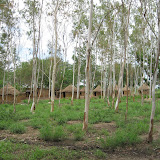
Back here in Bamako - the expensive taxis where only the metal frame of the door is left - pool parties in Military houses with ex-pats, NY Times photojournalists, Marines, architects, aid workers, all the Americans who are stranded together in this surreal world of pseudo western living in the poorest city in the world - I can't shake off the creepy feeling of this strange life here in the capital. I like the real Mali better. Well, sometimes.
I came here after a week long training session in Kita, where me and Foune'ba, the Matrone, developed plans for projects we want to work on in the next few months: getting electricity for the health center, cooking fortified porridge for the mothers of malnourished children, making mosquito repellent, etc. We met with several NGOs in the Kita Cercle, and had training sessions on how to deal with food security, an issue Peace Corps is stressing right now with the global food crisis.
Home has been the usual - great but a rough few weeks, I have barely been sleeping and my jaw hurts from grinding my teeth, I realized I really needed a break. In general I have been doing a lot of teaching at the health center and the school, talks on AIDS and pre-natal care, handwashing and birth spacing, etc. Kristin and I did some drawings with the crowded fourth grade Bambara class to send to the States for an art exchange program. All we had were my crayons and colored pencils and the flip-chart paper Peace Corps gave us, but the kids were thrilled and drew pictures labeled in Bambara of their huts (sobugu), drums (tam tams), millet pounding mortars (colon), donkeys (falli) and other things they see in their village. After they would finish a part of their drawing each one would come up I also helped out with a training session for community health workers (Relais) who are trained to go house to house to educate the villagers directly on general family practices such as malaria prevention, family planning and water sanitation.
I think the heat really is beginning to creep up on everyone - the feeling of suffocation clogs your mind and its hard to, well, just deal with anyone. Theres been alot of violence lately. Babies crying everywhere - my host father hits his son with a stick, goes back every time he whimpers, and sits there for the rest of the night slowly hitting it on the side of the house. Does it make you feel like a fucking man? I would love to ask, but I know I need to live with these people for two years, so I go home and draw furious charcoal sketches instead. His wife recently ran off with her 2 year old daughter to her boyfriend's, and he hasn't seen his baby since, I know he's sad. Sitting in my health center a huge commotion at my neighbors house. I watch as the 16 year old second wife runs out, I saw the birth of her baby a few months ago when she was still 15. The first wife and her husband run after her and grab her, each hitting her with a stick. She is screaming and I run halfway out but I know I can't help her. Someone stops them and she runs towards me, I lead her away and tell her to sit at the health center for a bit, just let her calm down for a minute, but no, my host father (who is the Vaccinator at the health center) yells at her to go back and draw water from the well. She stands at the well sobbing with the water pull in her hand, letting the rope down even though theres not even a bucket next to her. Her bright orange shirt reads: Rejoice With Me. I know, its not my place and not worth the risk to get involved. And they don't see any alternative. But hell, who's place is it then? For now, the disgust on my face tells them something, I hope.
So yes, I needed a break, and I am here in the air conditioned PC stage house with wireless internet and I want to go back already. But when I walk outside there is still the street food lady who sells rice and sauce under a shack covered with old rice sacks, and she'll make fun of me for being a Malinke and I'll joke with her about her ethic group. And I'm still in Mali after all.
Sunday, March 28, 2010

Thursday, March 11, 2010
Earth babies

My house is built from mud and wood -
I watched them make one just like it the other day, a crowd of shirtless men in dirty cotton pants weaved the soft new wood into a circle, glued with a slab on wet dirt; over it they spread more mud and made a cone shaped roof, added bundles of straw. Together they lifted the roof and it lay on the mud foundation, and that was that. No aluminum siding, or iron supports, no fiberglass insulation or plastic window frames. It is the earth and I am it –
The days here are now hot, it clings blanket like in the form of beads of moisture all over my body. It is exhausting and I nap for hours and wake up with raw heat rash on my neck and arms. Most days I sit under the mango tree outside my hut where the men spend those long daytime hours, under the little green mango bulbs that are threatening to unveil their seductive yellow-orange fruit and I can’t wait till they start to fall, they fall on our heads they say and we won’t be able to sit there anymore. And days like this I miss NY and the rage of art and music and people don’t stop, not even to drink tea but here it takes hours to brew and mix one small pot. Its dry here now and the vivid (slight hallucinations) I get from my malaria medication tips the straw roofs with an orange glow and the leaves of the trees are sometimes outlined in neon blue. I remember an early Francis Bacon painting I saw of an African boy squatting in a pale green yellow field, he’s alone and the field is immense and almost colorless but still bright against the dark boy, and I think damn did he get the simple fervor of this place. I feel sad knowing that these children will never be inside a gallery but there is art in the baby blankets they sew with big colored flowers and tie their babies to their backs. That’s as close as art can get, wrapping your little warm vulnerable family on your back.
And it is here the balance lies, the painful ignorance of love, the endless toil of Zen clad, monotonous labor. At times I feel such tragedy knowing that I have ever heard of a food processor, while women here gather around a big hollowed out wood mortar, three women in elegant fabric uniform from their head wraps to their skirts. They pound their grains together in the narrow bowl with heavy sticks bigger then they are, it’s a flawless rhythm – one, two, three – each brings the stick down from over her head, sometimes they clap as they throw the sticks in the air. Their daughters are next to them, sifting out the shaft from the pounded grain, it sounds like soft maracas. My own flabby arms feel songless after years of microwave buttons. But of course they toil and sweat under the grueling sun for hours, making meals for their families, they call this “husband work.” Of course they all want to go to America where its so much “easier.” Still I cringe at the thought of my dusty villagers in America – I can see them in sad crowded Harlem apartments and they don’t have their nieces to bring them gourds filled with peanuts but they can eat cheaply at McDonalds with a plastic fork, no Griot excited off Kola nuts will bless their sick babies and no one greets them and asks how the people in their home are, how they are feeling, how is the work in the fields – but their floors are made of dirt and their children are tiny from malnutrition and maybe this is all just romanticizing.
But I recall a scene from a month ago, the old traditional midwife (now phased out by western medicine) was attending a young woman’s birth as the usual Matron was having a baby of her own. Both were on a thin mat on the floor, the young woman in child’s pose grasping the midwife’s back while she squatted on a low wood stool, she was grasping the young woman as well. The woman’s head lay on her shoulder – and with each contraction they swelled and groaned together, as if the midwife as inseparable from the woman and taking her natural share of the pain (oh, Great Sisterhood!). They held each other, and the ground was there as well which rose up to meet them, the little arrows of gravitational force always pointing up, their support –
The most rational birth I’ve seen.
And so here I am in my house of mud and straw, it is friendly and cool in the heat of the day. After all, who needs iron when you are this close to the earth?
Thursday, February 25, 2010
its nice to be nice
Back here in Bamako, to the familiar smell of burning trash and fried plantains, the endless traffic sellers pushing phone credit up to the window. I've just come back after two weeks of travelling through Senegal and The Gambia: 70 hours of bus rides, street sandwiches of Maggi roasted goat meat and hard boiled eggs, gorgeous beaches and softball games of volunteers running around with drinks in their hands. Me and about 90 PCVs from Mali boarded two buses destined for Dakar, the beautiful beachside city on the Sengal Atlantic Coast, where the annual West African Invitational Softball Tournament is held. After a sweaty 30 hour ride we piled out of the bus and into the Club Atlantique, a shimmering oasis of America in the depths of West Africa. We were all overwhelmed at the incredible infrastructure in Dakar - sidewalk lined streets, tunnels instead of the infuriating traffic circles of Bamako, restaurants offering sushi, indian, thai, tapas! Heavenly. We met up with hundreds of volunteers from Senegal, The Gambia, Ghana, as well as the "refugees" from all the recently evacuated countries of Madagascar, Mauritania and Guinea. It was rambunctious as we had tons of energy bottled up from weeks in the African bush to expend, and that we did. We met some sweet young Moroccan med students and me and my friend went with them to Goree Island, one of the old slave ports of the Atlantic Coast. We sat on the beach with the boys as they played Moroccan music and 90s rock songs on the guitar, jumped off the boardwalk into the freezing cold bay. The place was filled with artists selling bright cloth paintings and sculptures of old pieces of plastic and metal. In the middle of the really lovely city of sandstone and a huge "castle" on a hill (built by the rich slaveowners)was the small slave house - a few rooms dark and cramped, with a tiny door that opened onto the sea. You imagined the men and women and children pushed out of their crowded rooms to line up at the small door that looked out to the ocean, where the boats waited destined for New York. Above the door was inscribed:
"De cette porte pour un voyage sans retour ils allaient, les yeux fixes sur l'infini de la souffrance."
This is the door for their voyage without return, their eyes fixed on the infinity of suffering.
As the tournament ended we hooked up with a group of volunteers from The Gambia, a sliver of former English territory in the middle of Senegal. After hours of waiting for the ferry we heard news that was was leaving immediately, and we ran with our bags and arrived in Banjul, the island capital where all the signs were in english and there is a whole strip of restaurants and clubs. We stayed in their Peace Corps house and we went to the beach down the street each day, as the male prostitutes in rastifarian attire, known as "Bumpsters," tried to pick us up with lines like "its nice to be nice!" and "can I make you happy?" It sounds strange but its one of the key draws to The Gambia - all along the beach you could see middle aged women with their muscular Bumpsters, sipping mango juice. We rented body boards and picked up shells to give as gifts to the children in our village and envied their ocean in dusty landlocked Mali.
A few of the Mali volunteers were going to a smaller island, so I tagged along. We hopped on the ferry back to the mainland, and found a jeep to take us through the brush. We blazed through the seemingly hidden path and got to a little cove on a river, where a few Gambians took us across on their brightly painted boats of hollowed out trunks. We had the Island to ourselves, and hung out with the Gambian farmers some of whom spoke Bambara and played us their drums, and we played in the huge waves on the rockless soft beach. Finally it was time to go home, and we boarded the bus destined for Bamako still dizzy with the bright day on the beach.
"De cette porte pour un voyage sans retour ils allaient, les yeux fixes sur l'infini de la souffrance."
This is the door for their voyage without return, their eyes fixed on the infinity of suffering.
As the tournament ended we hooked up with a group of volunteers from The Gambia, a sliver of former English territory in the middle of Senegal. After hours of waiting for the ferry we heard news that was was leaving immediately, and we ran with our bags and arrived in Banjul, the island capital where all the signs were in english and there is a whole strip of restaurants and clubs. We stayed in their Peace Corps house and we went to the beach down the street each day, as the male prostitutes in rastifarian attire, known as "Bumpsters," tried to pick us up with lines like "its nice to be nice!" and "can I make you happy?" It sounds strange but its one of the key draws to The Gambia - all along the beach you could see middle aged women with their muscular Bumpsters, sipping mango juice. We rented body boards and picked up shells to give as gifts to the children in our village and envied their ocean in dusty landlocked Mali.
A few of the Mali volunteers were going to a smaller island, so I tagged along. We hopped on the ferry back to the mainland, and found a jeep to take us through the brush. We blazed through the seemingly hidden path and got to a little cove on a river, where a few Gambians took us across on their brightly painted boats of hollowed out trunks. We had the Island to ourselves, and hung out with the Gambian farmers some of whom spoke Bambara and played us their drums, and we played in the huge waves on the rockless soft beach. Finally it was time to go home, and we boarded the bus destined for Bamako still dizzy with the bright day on the beach.
Tuesday, February 9, 2010
is a woman, is not a woman?
Disclaimer - This one is pretty graphic. It includes descriptions of female genital mutilation (FGM), childbirth and abuse.
These past few weeks have been - rough? eye opening? One wednesday morning I walked into the CSCOM, where I wasn't planning on staying long. Soon I found out that a woman was about to give birth, and I figured I would stick around to help out the Matrones as I normally do. I found the woman alone on the dirty, dusty floor of the recovery room, wiggling on her side as she rode through her contractions, all by herself. She looked older, probably in her forties with buzzed graying hair that looked bare and vulgar without her headwrap. Her American third-hand shirt was the color of the sandy ground, and a torn grey skirt was covered in her embryonic fluids. Perplexed by this site, I walked into the birthing room as the Matrones brought in a timid looking 19 year old. She had just given birth the day before, and as she was unable to make the 12 mile trek to the CSCOM she gave birth at home. The Matrones were yelling at her for not coming into the CSCOM to give birth as the girl looked down in shame. They put her on the birthing table, legs apart with her feet on the stirrups. And there it was. The scars from her circumcision had torn during the birth, leaving a wad of torn flesh where her clitoris should be, her labia torn. Likely, she was recircumsized in preparation of her impending birth, a common practice here. Traditionally, it is thought that a child should pass through a "purified" canal to enter the world. As if the clitoris is a septic tank. I was not suprised; 95% of women here undergo some degree of FGM, which ranges from cutting the clitoris to complete mutilation of the vagina. This, however, was far more extensive than any other mutilation I have seen. The doctor came in and began sewing the torn area. Of course, there is no anesthetic available, and the girl began breathing deeply with shut eyes as one of the matrones held her hands forcefully behind her head, yelling at her to keep her legs open. As the surgery continued, she left to tend to the birth of the woman on the floor. The girl in front of me was now writhing in pain, her eyes popping as she grips her thigh. I felt faint. I've seen much gorier surgeries before, but this tiny girl was wide awake and helpless. She screams as the doctor sews stich after stich. I know hes only doing his job, but at the moment I hate him as if he embodies all the men who allow this to happen. There is nothing to do but hold her hand. I am meditating to take away this pain in an area that should glow with pleasure and new life and is now a dark sewed up hole, a crater of pain which she is ashamed to feel. The rough work of the doctor and the cast off complaints of the Matrones who continue to yell at her "negligence" seem callous as she strains to keep her legs open.
When the surgery is over, twenty minutes later, the Matrones tell her to get up and throw her clothes, dismissing her without a thought to her pain and exhaustion. She carefully stands with eyes rolled back with tears and walks out, back to a 12 mile walk home to a husband I pray will leave her alone until she can heal. In the meantime, in the so called recovery room, Founeba finally pulls out an ashen, tiny infant from the writhing woman who doesn't seem to have much awareness of where she is or why shes there. She is muttering that the woman did not have any pre-natal consultations. The baby is premature, tiny and grey and barely breathing. But its alive. I am often amazed here at the resilliance of the human body, especially the fragile infants that always seem to just make it. And truth is, too many of them don't (infant mortality rate here is 15%). But back to the woman who now lies on a dirt and blood covered mat on the floor. Founeba is yanking at the whitish grey umbilical cord as if its a pulley, but its still apart of this woman now and I can almost see her uterus jerking with each pull that I can measure by her breathy moans. The afterbith won't come out. I breathe in as I watch Founeba dig her hand all the way to her wrist, and she is twisting her hand trying to grasp the placenta while the womans moans are deeper now and pleading. After a minute she pulls the spongy mass out, and I think of movies where the medicine man pulls out a human heart through his mouth. It all seems ridiculous but also perfectly rational and completely real. And so its done. The woman is helped up and shown the bed where her baby lays, and she lies next to it like so many mothers here I've seen, looking absolved yet newly burdened, exhausted.
It is difficult to watch these scenes, obviously, and I am always toying with the question: what is a woman here? What makes them different then what I'm used to? As an individual they seem like a non-entitiy, medlded into 13 year old brides and 15 year old mothers. I think one of the most frightening things about the day was what I interpreted as the apathy of the matrones, at least in their exterior behavior. Yes, patient care here has never really been prioritized, albeit mentioned, in their health trainings. It often seems like their idea of "professionalism" goes hand in hand with a sense of superiority, which comes across as condescending, intimidating. But I think one of the survival tactics for al women is the all too familiar victim blame. Because if its the woman's fault for not going to her pre-natal consultations or trekking 12 miles to give birth, then this will never happen to them. Blaming their men for not paying for their wives' healthcare, or blaming tradition for continuing this damaging pracice of FGM - these are huge barries, and not in their immediate control. So instead of a sisterhood of understanding they villianize their neighbors or just look the other way.
A few days later I was telling my sitemate about what I saw. She told me about the day before, looking out at the road that connects to our villages and seeing a girl wedged between two men, who was sobbing as the men hit her. As the bus stopped for a minute, two of the men in her village jumped into the bus with sticks to help in her beating. My friend knew these two men well. She asked her host mother why they were beating her, what she had done. The girl was on her way to a village to marry a man, miles away from her family and her boyfriend, who she was forbidden to marry as she was promised to his other man. How dare she cry. We both sat with tears, because, goddamnit, this is not just a TV commericial, this is our home now and our neighbors and friends. And its hard to not feel helpless.
The reason for my visit to her village was a different wedding, that of her host brother. During the two day long celebration, the bride is concelead under a thick white sheet that covers her face, as she does her "bride duties" of washing dishes and cleaning. This tradition is to hide her face, as the young brides are normally sobbing through it all. Its not so different than our wedding veils, but until now I never imagined its role this way. Here though, it is perfectly logical. Its fine that they are leaving their families at 12 to marry strangers. The message is clear - just hide the tears and pretend its all ok, for traditions sake.
But most of the time I don't feel so helpless. A week later one man from my village's health committee came to me after attending a conference against FGM, and my doctor and matrones and I discussed how it is an important issue to breach here. We discussed beginning some campaigns in my village to raise awareness about its dangers. This week I also saw one of my host mothers pack her bag after I witnessed my host father try to attack her during some argument before dinner. Maybe she'll come back, maybe not. But I was proud that she stood up to him. And yesterday, I got a ride into Kita with the my doctor. He was on his way to the Gendarmerie to file a police report against a teacher who raped his wife's 13 year old sister. He was angry, and told me how this is a real issue here. And the more I talk with the younger women in my village, the more I see their desire for change. The girls in high school tell me they want to wait to get married, go to high school and maybe university. No more hiding, please.
These past few weeks have been - rough? eye opening? One wednesday morning I walked into the CSCOM, where I wasn't planning on staying long. Soon I found out that a woman was about to give birth, and I figured I would stick around to help out the Matrones as I normally do. I found the woman alone on the dirty, dusty floor of the recovery room, wiggling on her side as she rode through her contractions, all by herself. She looked older, probably in her forties with buzzed graying hair that looked bare and vulgar without her headwrap. Her American third-hand shirt was the color of the sandy ground, and a torn grey skirt was covered in her embryonic fluids. Perplexed by this site, I walked into the birthing room as the Matrones brought in a timid looking 19 year old. She had just given birth the day before, and as she was unable to make the 12 mile trek to the CSCOM she gave birth at home. The Matrones were yelling at her for not coming into the CSCOM to give birth as the girl looked down in shame. They put her on the birthing table, legs apart with her feet on the stirrups. And there it was. The scars from her circumcision had torn during the birth, leaving a wad of torn flesh where her clitoris should be, her labia torn. Likely, she was recircumsized in preparation of her impending birth, a common practice here. Traditionally, it is thought that a child should pass through a "purified" canal to enter the world. As if the clitoris is a septic tank. I was not suprised; 95% of women here undergo some degree of FGM, which ranges from cutting the clitoris to complete mutilation of the vagina. This, however, was far more extensive than any other mutilation I have seen. The doctor came in and began sewing the torn area. Of course, there is no anesthetic available, and the girl began breathing deeply with shut eyes as one of the matrones held her hands forcefully behind her head, yelling at her to keep her legs open. As the surgery continued, she left to tend to the birth of the woman on the floor. The girl in front of me was now writhing in pain, her eyes popping as she grips her thigh. I felt faint. I've seen much gorier surgeries before, but this tiny girl was wide awake and helpless. She screams as the doctor sews stich after stich. I know hes only doing his job, but at the moment I hate him as if he embodies all the men who allow this to happen. There is nothing to do but hold her hand. I am meditating to take away this pain in an area that should glow with pleasure and new life and is now a dark sewed up hole, a crater of pain which she is ashamed to feel. The rough work of the doctor and the cast off complaints of the Matrones who continue to yell at her "negligence" seem callous as she strains to keep her legs open.
When the surgery is over, twenty minutes later, the Matrones tell her to get up and throw her clothes, dismissing her without a thought to her pain and exhaustion. She carefully stands with eyes rolled back with tears and walks out, back to a 12 mile walk home to a husband I pray will leave her alone until she can heal. In the meantime, in the so called recovery room, Founeba finally pulls out an ashen, tiny infant from the writhing woman who doesn't seem to have much awareness of where she is or why shes there. She is muttering that the woman did not have any pre-natal consultations. The baby is premature, tiny and grey and barely breathing. But its alive. I am often amazed here at the resilliance of the human body, especially the fragile infants that always seem to just make it. And truth is, too many of them don't (infant mortality rate here is 15%). But back to the woman who now lies on a dirt and blood covered mat on the floor. Founeba is yanking at the whitish grey umbilical cord as if its a pulley, but its still apart of this woman now and I can almost see her uterus jerking with each pull that I can measure by her breathy moans. The afterbith won't come out. I breathe in as I watch Founeba dig her hand all the way to her wrist, and she is twisting her hand trying to grasp the placenta while the womans moans are deeper now and pleading. After a minute she pulls the spongy mass out, and I think of movies where the medicine man pulls out a human heart through his mouth. It all seems ridiculous but also perfectly rational and completely real. And so its done. The woman is helped up and shown the bed where her baby lays, and she lies next to it like so many mothers here I've seen, looking absolved yet newly burdened, exhausted.
It is difficult to watch these scenes, obviously, and I am always toying with the question: what is a woman here? What makes them different then what I'm used to? As an individual they seem like a non-entitiy, medlded into 13 year old brides and 15 year old mothers. I think one of the most frightening things about the day was what I interpreted as the apathy of the matrones, at least in their exterior behavior. Yes, patient care here has never really been prioritized, albeit mentioned, in their health trainings. It often seems like their idea of "professionalism" goes hand in hand with a sense of superiority, which comes across as condescending, intimidating. But I think one of the survival tactics for al women is the all too familiar victim blame. Because if its the woman's fault for not going to her pre-natal consultations or trekking 12 miles to give birth, then this will never happen to them. Blaming their men for not paying for their wives' healthcare, or blaming tradition for continuing this damaging pracice of FGM - these are huge barries, and not in their immediate control. So instead of a sisterhood of understanding they villianize their neighbors or just look the other way.
A few days later I was telling my sitemate about what I saw. She told me about the day before, looking out at the road that connects to our villages and seeing a girl wedged between two men, who was sobbing as the men hit her. As the bus stopped for a minute, two of the men in her village jumped into the bus with sticks to help in her beating. My friend knew these two men well. She asked her host mother why they were beating her, what she had done. The girl was on her way to a village to marry a man, miles away from her family and her boyfriend, who she was forbidden to marry as she was promised to his other man. How dare she cry. We both sat with tears, because, goddamnit, this is not just a TV commericial, this is our home now and our neighbors and friends. And its hard to not feel helpless.
The reason for my visit to her village was a different wedding, that of her host brother. During the two day long celebration, the bride is concelead under a thick white sheet that covers her face, as she does her "bride duties" of washing dishes and cleaning. This tradition is to hide her face, as the young brides are normally sobbing through it all. Its not so different than our wedding veils, but until now I never imagined its role this way. Here though, it is perfectly logical. Its fine that they are leaving their families at 12 to marry strangers. The message is clear - just hide the tears and pretend its all ok, for traditions sake.
But most of the time I don't feel so helpless. A week later one man from my village's health committee came to me after attending a conference against FGM, and my doctor and matrones and I discussed how it is an important issue to breach here. We discussed beginning some campaigns in my village to raise awareness about its dangers. This week I also saw one of my host mothers pack her bag after I witnessed my host father try to attack her during some argument before dinner. Maybe she'll come back, maybe not. But I was proud that she stood up to him. And yesterday, I got a ride into Kita with the my doctor. He was on his way to the Gendarmerie to file a police report against a teacher who raped his wife's 13 year old sister. He was angry, and told me how this is a real issue here. And the more I talk with the younger women in my village, the more I see their desire for change. The girls in high school tell me they want to wait to get married, go to high school and maybe university. No more hiding, please.
Wednesday, January 27, 2010
so this is the new year

Tonight the glaring arbitrary nature of time seemed to unfold to me – the idea of “now” and “modern” and how much it contrasts between here and America. To me this really reveals the strange and, well, unrealistic way we think of time as if it doesn't need a context. We've entered 2010 now – a year that sounds incredibly futuristic, covered in chrome and white plastic and slow electronic music. And in America, 2010 means a certain type of modern: little hand-held computers like the Ipod touch and the global environmental crisis and stem cell technology and GM food, even the 3-D televisions I hear are about make its way onto the market. And its a necessity to have several cars per family and a laundry machine, or it has been for the past 50 years. But here, modern progress means schools that are based on a government regulated system (albeit loosely and haphazardly) and cell phones complete with the one square foot service spot in the middle of the cornfield, where I need to stand on a rock and wave my phone in the air. No matter that they missed an entire century of landlines. But reality here is that only the lucky few can even afford a phone, or have anyone they know outside of the village that they care to talk to. Hence, the only form of communication really accessible outside the village is the dusty RAC radio in the health center crowded with doctors and other staff from the region screaming about emergency calls from a city days away. And in the village we have the local Griot, a town crier who can yell the news to the only people they need to hear it from.And then there's the new car that the doctor just bought, easily the wealthiest person in the village, after maybe the Mayor. His 1991 Toyota with the scraped off paint and rusty stick shift is one of the shiniest things the village has seen. The donkey cart is the main mode of transportation. They thought I was crazy when I described a clothes washing machine; the one tap recently installed in our village seems like enough of a luxury when you can spend an extra minute drawing water from the well.
And hey, that's progress. That's now.
Sunday, January 24, 2010
pocket full of peanuts

My pockets are full of peanuts - or rather, the little sack I bring around with me each evening as I make my neighborhood rounds - along with my soap for washing my hands, my sacred flashlight (the solar rechargeable batteries quickly fading), my notebook and a real ink pen which I splurged on at the Tubab store in Bamako. After my cold bucket bath beneath a fading orange sun - which blazed with fury 30 minutes ago - I lock my tin doors and walk down the short dirt path to Founeba's house, making sure to avoid the goat shit and broken Baobab fruit with its white chalky center scraped out by the grubby hands of some bare bellied toddler. I pass the piles of peanut shells, the last ground remains of the waning peanut harvest season, and stacks of irregular mud bricks freshly molded from the cool earth. Foune'ba is probably sitting on the low wood stool in front of a black iron pot licked by low flames, which is propped on a pile of dried mud, creating a stovetop of sorts. With a wood stick she is stirring the sauce bubbling in the pot - tiga dega na (peanut butter sauce) or saga saga na (a slimy leaf sauce) - which she'll taste and add more Maggi or peanut butter like precious bit of gold ore. I read to her as she tends to the sauce and her two month-old baby Omou who is swathed in bright patterned cloth with her brown little face quietly looking out. When the sauce is done she gives Omou her breast and I hand her the health manual from which I've been reading, and help her stumble through the Bambara translation which I can read fluently since I've grown up sounding out letters but she has only learned to read since her training to become a midwife. I envy her understanding even if she still confuses every n and m and I've learned that for both of us it will come, dooni dooni (small small). We read about AIDS in Mali as she gasps at the statistics, or about weaning children off breast milk without creating protein deficiencies, or the importance of vaccinations. And while yesterday she was angry at me for leaving to visit Kristen on the slow Saturday, and even more for my carelessness in leaving my chair and soap outside which to her feels like an ostentatious show of my money, we're over it. We both know were differed - I resent the mother like role she tries to take which is really just communal coexistence regardless of our professional relationship, and she doesn't always grasp my American independence. We're both learning.
After the darkness begins to filter in I say my night blessings and take off for my host families house as one of Founeba's daughters (or one of her husband's other daughters, she's wife number 4) follows with a bowl of sauce and rice sitting on her head without the slightest threat of its downfall. The women carry themselves with model like stability despite the threat of their dangling earrings. I eat dinner with my host father and his two younger sons; his older sons are off at the nearest high school, 2 hours away in Kita. I wash my hands with the soap which I have been offering them for months but they finally accept, which could have something to do with the big hand washing mural I've just finished on the wall of the health center. We all squat around the bowl on the floor as he grunts and holds the flashlight. Tonight Sani is making dublini, hibiscus tea. It is heavy and sweet with its fragrant magenta juice and equal parts sugar. A group of her classmates show up. Their presence is at a first glance imposing; their tall thin figures draped in bright panyes which don't match their skirts, which don't match their shirts or their headwraps anyway. Their swirling palate of color is lit by the bonfire which we sit around, and in fact all I can see are the distant family bonfires where the women squat on low stools around their endless children snacking on their after dinner roasted peanuts. The complete night scene is only broken by an occasional anonymous passerby with their flashlight whispering good evening with equally whispered responses from attentive ears. As the girls sit down the intimidation fades as I recognize each face - 13 and 14 year olds, strong and emboldened by their impending roles as wives and mothers only a year or two away. Even some classmates their age carry their notebooks atop their round stomachs.
As my host mother Hagie shells the peanuts in a weaved bowl the group alternates between pensive silence, complete and comfortable as they stare into the fire, and lively gossip about the village. I am slowly beginning to carve out the Malinke words and phrases from the dark cloud of sounds, which I can connect to the Bambara words I've learned and sew together with context, the quilt of Malian languages. Their chatter sounds like drum and base; their tongues heavy with h and j sounds, interrupted sporadically by the quick high pitched l's and k's.
After long stretches of silence I feel I've put in some decent "family time" and move on to the next concession over, Soliba's house. Here I sit down amidst a warm chorus of greetings and bubbling children who run up to me and smile. I sit down on the wood bench, relieved that they don't scurry to get me a better chair - the respectful motion always embarrasses me, and anyway I'd much rather sit next to my friends with their children at my knees. Some of the toddlers lay on my lap and try to play with my hair, which they still can't believe is connected to my head, and mutter questions that I have no chance of understanding with their lispy Malinke tongues. I am teaching Soliba English, and we've gotten a few phrases down that she's asked to learn. These are of the utmost importance here: "Come eat!" "Lets go to Behon," and "How is your family?" These frequent Malian phrases sound random and quite useless in the American English. But of course language is so much more than just a string of sounds; it is entwined with all the peculiar way each culture lives, what they value, what is respectful or even trivial in this little Malian culture that is, well, the whole world. At least to them, and for this moment me too.
Sunday, January 3, 2010
Monsieur BonBon
 I'm back in Bamako after an incredible hike through Dogon country.
 We took the 12 hour bus ride up to Sevrae and spent the night there. We ate ouijila, a huge ball of dough in curry like sauce, surprisingly delicious and a lovely deviation from rice and peanut sauce. The next day we headed out to Sam's village in Sanga. As we bounded through the sandy road, the beige sandstone huts reminding me of Jerusalem, we were accosted by the pleasant aroma of chives, one of their primary sources of income. The kelly green fields were quite a contrast to the sandy mountains, the only vegetation besides the tall thick baobab trees stubbornly pushing through the rocks, their bulbous fruit hanging off the almost bare branches like macabre Christmas ornaments. We all teemed with jealousy as we climbed up the cliff to get to Sam's house, located on a summit overlooking the green chive valley and streams, the
mountains looming in the distance. We slept on the roof and woke up each morning up to dusty sunrises.

We spent a few days in Sanga, climbing our way over to the marketplace where the women sold dyed indigo fabrics, mangoes and wood carvings. The Dogon mask festival was beginning, and it was strange feeling like a tourist as we bumped into groups of westerners. While officially Muslim, most Dogon people still hold fast to their traditional animist beliefs of spirits which they call "genies." Many of the houses had different mud decorations on their roofs, signifying each person's profession: medicine man, goat hunter, clothmaker. We visited the house of the "Oldest Man," who acts as an arbiter for disputes among villagers. The low ceilings prevented any man from standing up so that no man is above another, even in the heat of an argument.

Christmas night we watched a dance competition. Men and women in blue indigo robes spun and danced with the fury in the middle of a crowd of spectators. Still, it felt limp in contrast to the drum circles in my village, maybe less inspired in front of the crowd of spectators. Or maybe I just miss my village. Afterwards we had a huge Christmas dinner that Sam and her host family made at the Mayor's house, complete with a roasted goat on a huge spit, and millet beer. After dinner her villagers surprised us with a welcoming dance. Each quartier of the village presented themselves, dancing in line to the persistent beat while playing their wooden flutes. As they reached us they began to crouch down, holding a medallion of mirrors and white tile. Finally they would end up on their knees, offering the plate to us as everyone in the circle shook their hips and sang. After each neighborhood went they began to pass the medallion to each of us, and we followed suit in presenting ourselves to the villagers.

The next day we began our three-day hike. It began with a steep climb down the mountain, where Malian adolescents rushed to help us down the gaping drops and slippery rocks. We continued on to some of the villages in the cliffs. Each village seemed piled vertically on the side of the mountains, at incredible heights for daily hour long trips to get to water or food. Its amazing what people can get used to. Centuries of isolation from the surrounding cliffs with little water has proven the endurance of the Dogon people. Our guide explained that these villages were located among the higher cliffs where they could see approaching tribes that threatened to steal their goats or children. As we entered each village we were accosted by long-legged Malian children, their faces pale with the desert dust. Divide and conquer they would, following us with their well rehearsed French phrases asking for very particular items: "Monsieur BonBon?" (Mr. Candy?), "Cava Bidon?" (How are you, water bottle?), or "Madame Bici!" (Mrs. Pen!). After almost six months in our villages, we've become a bit jaded with the these children, after all we have our own village kids to take care of! And we're all more concerned about their protein intake then their sugar. Although we were happy to pass off our empty water bottles. We passed the various sacrificial spots, where goats would be killed for good health, or a potion of millet and baobab fruit are offered to increase the town's fertility. After 10 kilometers of hiking up and down the mountain we stopped exhausted for lunch, all 16 of us passing out on concrete slabs immediately afterward. We woke ourselves up for another 5k walk through the thick sand to our hotel. The church behind us was having their service - singing and dancing for hours. We slept on the hotel roof, freezing in the desert air.

The next day, despite our aching legs and blistering feet we headed out again. We began to feel better as we climbed, breathing the clean air. After passing a few villages on the way we reached the old Telem villages, which are roundish irregular stone dwellings carved into the side of the mountain. Its no wonder that the Dogon tribe, who overtook the Telems, believed that the Telems could fly when looking impossibly high homes on the almost vertical rockcliffs. The Dogon now use those cave-like dwellings as burial places, using rope to lower the bodies from the higher cliffs into the chambers. At last we made it to the mountain peak and sat watching the sweeping panoramic of the plateau below us.
Incredible. But I can't wait to get back to my village. I miss my home.
Subscribe to:
Posts (Atom)